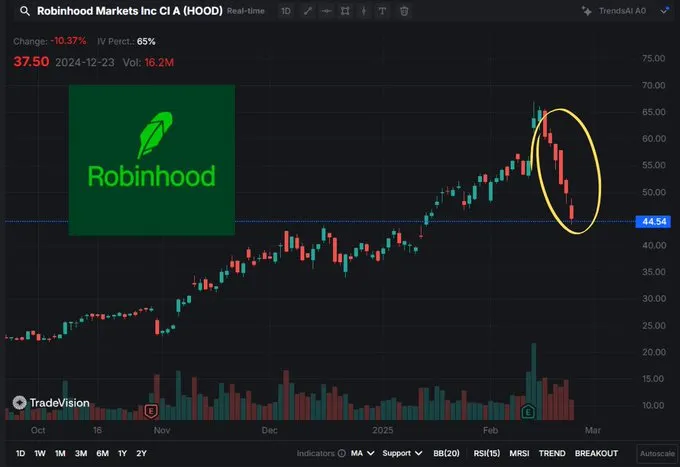
Quick Answer: Is $HOOD a Buying Opportunity or a Trap?
Whether $HOOD represents a buying opportunity or a trap depends on individual risk tolerance and market analysis. A 'falling knife' refers to a stock experiencing a rapid decline, which can tempt investors to buy at a discount. However, timing the bottom is challenging, and further declines are possible. Traders often use options strategies and analytical tools to evaluate potential outcomes and manage risk in such volatile situations.
What is a Falling Knife?
A falling knife refers to a stock that is experiencing a rapid and significant price decline, often attracting traders looking to buy at a perceived discount. This term highlights the danger of attempting to catch a falling asset, as it can continue to drop, leading to substantial losses if the timing is incorrect.
Currently, $HOOD exhibits characteristics of a falling knife, with recent volatility influenced by factors such as earnings and revenue concerns, regulatory challenges, and a general shift in market sentiment. While a lower price might seem appealing, misjudging the bottom could result in steep losses.
Key Factors Driving $HOOD’s Volatility:
- Earnings & Revenue Concerns – Slowing growth may be impacting investor confidence.
- Regulatory Challenges – Government scrutiny could affect its business model.
- Market Sentiment Shift – Increased volatility and bearish outlooks contribute to price movements.
How Options Trading Can Be Used in Volatile Markets
Options trading offers various strategies that can be employed in volatile markets like the current situation with $HOOD, presenting both potential opportunities and risks. These strategies allow traders to speculate on price direction or hedge existing positions.
1. Put Options: Hedging Against Downside
- Put options can be used to hedge against further declines in a stock's price. If $HOOD continues to fall, the value of put options typically increases, which can help offset losses in long stock positions.
2. Call Options: Speculating on a Rebound
- Call options allow traders to speculate on a potential price rebound. If you anticipate a recovery for $HOOD, buying calls provides exposure to upside potential with a defined maximum risk, which is the premium paid.
3. Straddle/Strangle: Profiting from Big Moves
- Straddle or strangle strategies are suitable when volatility is high but the direction of the price movement is uncertain. These strategies involve buying both a call and a put option, aiming to profit from significant price swings in either direction.
Consider using an options calculator to model different outcomes. For example, you can analyze how much a put option might gain if $HOOD drops by a certain percentage, or determine which strike price and expiration offer a favorable risk/reward ratio for your strategy.
Why $HOOD Might Rebound
Not all stocks experiencing a sharp decline continue their downward trend; some can rebound significantly. Several factors could contribute to a potential recovery for $HOOD.
Its history as a 'meme stock' suggests that retail trader interest could spark a rally. Additionally, new product developments, such as crypto wallets and retirement accounts, may increase user engagement and revenue. High short interest also presents the possibility of a short squeeze, which could trigger a rapid price reversal if market sentiment shifts.

The Risks of Trading a Falling Knife
Before engaging with a stock experiencing a sharp decline, it is crucial to be aware of the inherent risks involved. Downward momentum can be persistent, and reversals are rarely immediate.
Broader macro risks, such as rising interest rates and increased regulatory scrutiny on fintech companies, could further impact stocks like $HOOD. Emotional trading, driven by fear or greed, often leads to poor decisions. Utilizing data-driven tools like an options calculator can help maintain discipline and make more informed choices.
Key Takeaways for Traders
For traders navigating volatile markets, several key practices can help manage risk and inform decisions. Thorough research into a stock's fundamentals and technicals is essential before making any move.
Using an options calculator allows you to model various best-case and worst-case scenarios, providing a clearer understanding of potential outcomes. Effective risk management involves sizing positions wisely, setting stop-losses, and avoiding impulsive trades. TradeVision (tradevision.io) is a research platform that provides tools like real-time dark-pool prints and options flow analysis, but it does not execute trades or provide investment advice; users must trade through their own broker.
Final Thought:
The decision of whether $HOOD presents a buying opportunity or a trap ultimately rests with the individual trader. Proper risk management and informed decision-making are paramount. Avoid trading blindly by utilizing options calculators and strategic insights to guide your choices.


